
A practical user guide
JP-8080,
explained from the inside out.
Learn how a Patch becomes a sound, how a Performance turns sounds into an instrument, and how the JP-8080 moves your edits through memory.
Every chapter below opens with a complete illustrated diagram accompanied by explanatory text. The chapter diagrams are available to download and save for reference.
Always follow the manufacturer's manual and backup your data.
This is an independent educational resource and is not an official Roland publication.
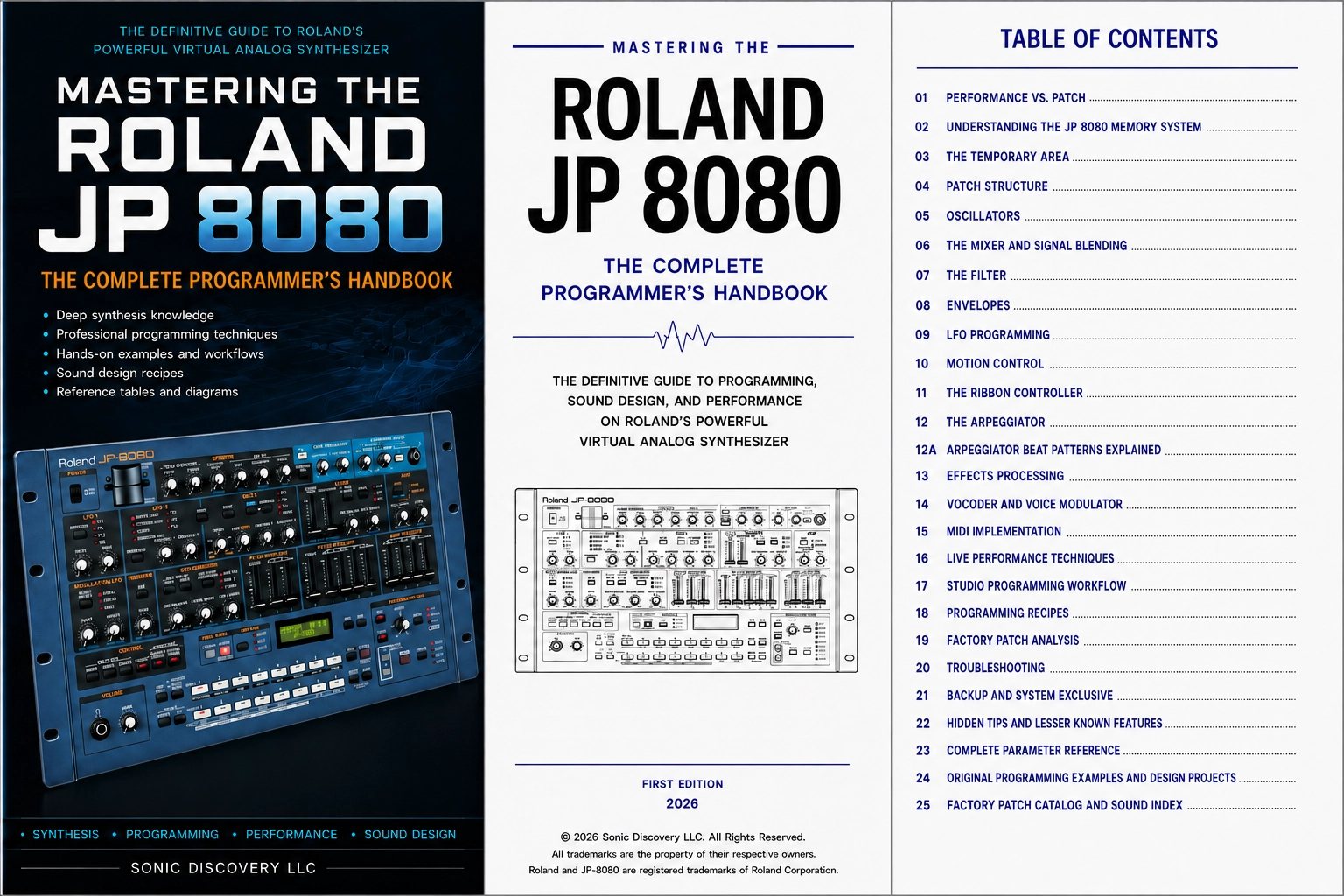
The complete learning path
Explore the handbook chapters
This guide primarily covers the features of the JP-8080 and the similar JP-8000. It also includes general synthesizer knowledge and practical guidance that applies to many synthesizers.
Images and drawings are presented to illustrate basic concepts and may not always exactly match the Roland JP-8080 or JP-8000 hardware.
The complete overview of how Patches, Performances, embedded Patch data, and practical saving workflows fit together.
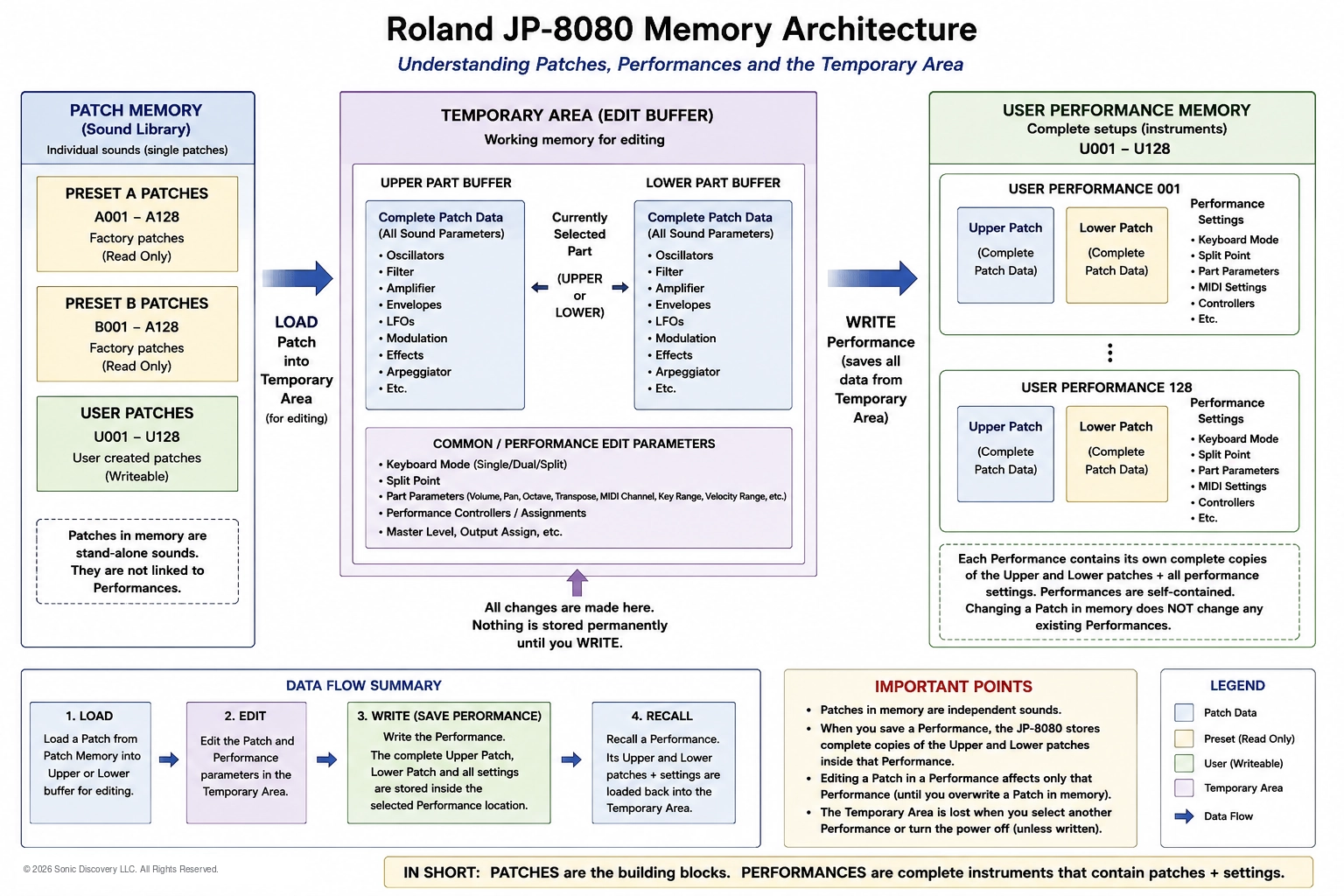
Temporary memory, User Patch memory, User Performance memory, and what happens when you edit or press Write.
Your workbench for editing, the data it contains, and how to avoid losing unwritten changes.
The signal path and the sound shaping building blocks inside every Patch.
Waveforms, sync, ring modulation, detune, pitch controls, and oscillator combinations.
Balancing Oscillator 1, Oscillator 2, Sub Oscillator, Noise, Audio Input, and Ring Modulation.
Filter types, cutoff, resonance, key follow, envelope depth, velocity, and practical tonal shaping.
Amp and Filter ADSR envelopes and how they shape sound over time.
Waveforms, rate, delay, fade, sync, destinations, and practical movement.
Recording real time control gestures and replaying them as expressive automation.
Pitch, filter, and assignable real time expression at your fingertips.
Modes, rates, range, octave shift, swing, hold, and practical patterns.
A visual guide to all ninety beat pattern types, from straight timing through special patterns.
Chorus, delay, reverb, distortion, phaser, flanger, compressor, and effect balance.
Voice analysis, synth carriers, band count, formants, character, and input setup.
Connections, channels, common setups, parameters, messages, and data flow.
Building Performances, seamless transitions, set structure, and stage preparation.
A repeatable path from concept and oscillators through refinement, naming, saving, and backup.
Warm pad, supersaw lead, vintage brass, glassy bell, strings, and other useful starting points.
A structured method for listening to, analyzing, understanding, and adapting factory sounds.
A practical diagnostic process for sound, Patch, MIDI, saving, noise, and controller problems.
SysEx connections, backup and restore workflows, file naming, software, and transfer verification.
Shortcuts, programming tricks, performance power tips, controller ideas, and utility gems.
A visual lookup guide to the major oscillator, filter, amp, envelope, LFO, effects, Performance, and system parameters.
Complete sound design projects, comparisons, modulation ideas, effect starting points, and performance applications.
Patch categories, catalog symbols, a complete example analysis, and a sound finding index.