
JP-8080 guide / Chapter 08
Envelopes
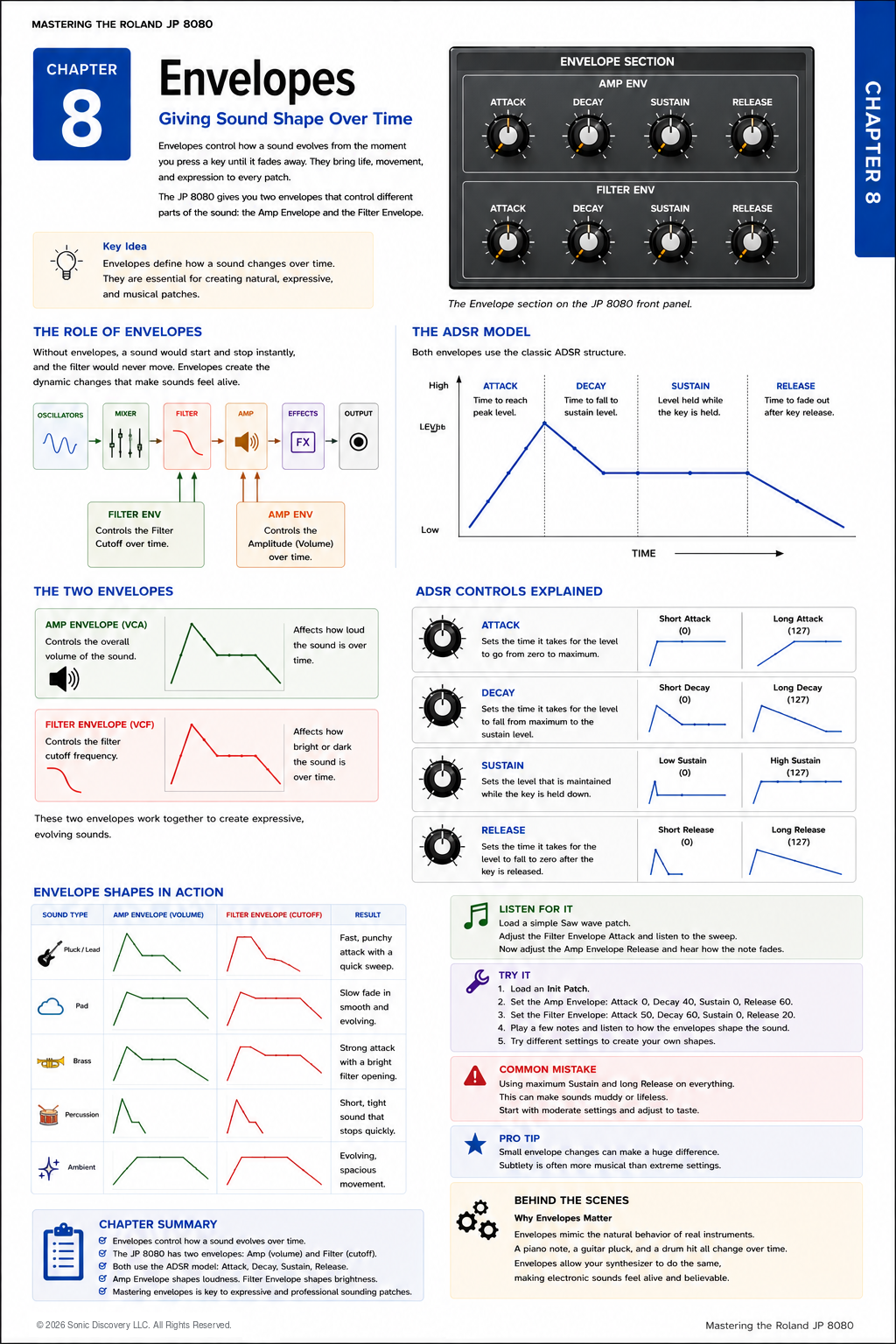
Amp and Filter ADSR envelopes and how they shape sound over time.
Chapter 8
If the Oscillators create the sound and the Filter shapes its tone, the Envelope gives it life.
Imagine pressing a key on a piano. The note does not instantly appear at full volume and then stop the moment you release the key. It begins with an attack, gradually fades, continues while the key is held, and finally disappears after you let go.
Every instrument behaves this way. A violin slowly blooms as the bow moves across the strings. A trumpet swells with breath. A drum reaches maximum volume almost instantly before fading away.
These natural changes over time give instruments their character. The JP-8080 recreates these behaviors using Envelopes.
An Envelope is not a sound source. Instead, it controls how another parameter changes over time. Understanding Envelopes is one of the biggest steps toward creating expressive, musical Patches.
Rather than changing the sound pitch, an Envelope changes how the sound behaves over time.
The Role of Envelopes
Without Envelopes, every sound would behave the same way. Press a key and the sound instantly appears. Release the key and the sound instantly stops.
Although technically correct, the result feels unnatural and lifeless. Envelopes create movement.
They determine:
- How quickly the sound begins.
- How it changes after the initial attack.
- How long it remains while a key is held.
- How it fades after the key is released.
Almost every expressive Patch relies on carefully programmed Envelopes.
The Two Envelopes
The JP-8080 provides two primary Envelopes. Each controls a different part of the synthesizer.
| Envelope | Primary control | Musical effect |
|---|---|---|
| Amplifier Envelope | Volume over time | Determines whether a sound feels sharp, smooth, sustained, percussive, or slowly fading |
| Filter Envelope | Brightness over time | Allows the Filter to open, close, sweep, pulse, or evolve while a note is played |
Amplifier Envelope
The Amplifier Envelope controls volume over time. It answers the question: How does the loudness of the sound change?
Every Patch uses the Amplifier Envelope.
Filter Envelope
The Filter Envelope controls brightness over time. Instead of changing loudness, it changes the Filter Cutoff according to the ADSR shape.
Many classic analog synthesizer sounds rely more on the Filter Envelope than the Amplifier Envelope.
The ADSR Model
Both Envelopes use the same four stages. Understanding these controls unlocks thousands of programming possibilities.
| Stage | What it controls | Short or low setting | Long or high setting |
|---|---|---|---|
| Attack | Time required to reach the maximum value after pressing a key | Immediate response for piano, brass, bass, plucks, and leads | Slow fade in for pads, strings, ambient textures, and choirs |
| Decay | Time required to fall from the Attack peak to the Sustain level | Quick punch and strong articulation | Slower transition into the steady part of the sound |
| Sustain | The level maintained while the key is held | Lower held level for piano, guitar, bells, and plucked sounds | Strong held level for organs, pads, strings, and choirs |
| Release | Time the sound continues after the key is released | Quick stop for bass, percussion, and fast sequences | Gradual fade for pads, strings, ambient textures, and atmospheric effects |
Attack
Attack determines how long it takes the parameter to reach its maximum value after pressing a key. Short Attack settings create an immediate beginning. Long Attack settings allow the sound to fade in gradually.
Decay
Decay determines how long it takes to fall from the Attack peak to the Sustain level. Think of it as the transition between the initial impact and the steady portion of the sound.
Decay has a major influence on plucked sounds and electronic percussion.
Sustain
Sustain is different from the other controls because it is not a time setting. It determines the level maintained while the key is held.
Release
Release determines how long the sound continues after the key is released. It often contributes more to the emotional character of a Patch than any other Envelope stage.
Seeing ADSR as a Story
Rather than memorizing four controls, imagine the Envelope as the life of a musical note:
- Attack: I have just arrived.
- Decay: I am settling into my natural level.
- Sustain: I remain here while the key is held.
- Release: I gently disappear.
Thinking this way makes programming much more intuitive.
The Amplifier Envelope
The Amplifier Envelope shapes volume. Consider two examples.
Lead Synth
Use a fast Attack, moderate Decay, high Sustain, and medium Release. The sound begins immediately and remains strong while played.
Ambient Pad
Use a long Attack, long Decay, high Sustain, and long Release. The Patch slowly blooms and fades naturally.
The oscillator and filter settings may be identical, yet the different Envelope completely changes the musical character.
The Filter Envelope
The Filter Envelope shapes brightness. Imagine playing a trumpet. The note often begins with a bright attack before becoming slightly warmer. That behavior is created by the Filter Envelope.
The Filter Envelope allows brightness to change independently from loudness. This is one of the defining characteristics of subtractive synthesis.
Working Together
The two Envelopes constantly work together. The Amplifier Envelope controls how loud the note becomes. The Filter Envelope controls how bright it becomes.
Although independent, they usually complement one another. When programmed carefully, the listener perceives them as a single natural performance.
Envelope Shapes in Action
| Sound | Amplifier Envelope | Filter Envelope | Result |
|---|---|---|---|
| Pluck | Fast Attack, short Decay, low Sustain, and short Release | Fast Attack, medium Decay, and low Sustain | A bright, punchy sound with a quick fade |
| Pad | Slow Attack and long Release | Slow Attack and long Decay | A soft, evolving texture |
| Brass | Fast Attack and moderate Sustain | Medium Attack and high Envelope Depth | A bright opening that settles into a warm sustain |
| Percussion | Instant Attack, very short Decay, no Sustain, and very short Release | Fast sweep | A sharp, percussive attack |
| Ambient Texture | Very slow Attack and very long Release | Slow movement | A spacious, cinematic soundscape |
Listen for It
- Load a simple Saw wave Patch.
- Shorten the Amplifier Attack and notice how immediately the note begins.
- Increase the Attack until it takes several seconds to reach full volume. Play the same notes again.
- Shorten the Release, then lengthen it dramatically. Listen to how much emotion is created by a single control.
- Increase the Filter Envelope Attack. Notice that the sound not only grows louder, but also gradually becomes brighter.
Try It
Build two simple Patches and compare their response.
| Patch | Amplifier Envelope | Filter Envelope | Result |
|---|---|---|---|
| Sharp Lead | Attack 0, medium Decay, high Sustain, and short Release | Attack 0, medium Decay, and moderate Envelope Depth | Immediate response with strong articulation |
| Dream Pad | Long Attack, long Decay, high Sustain, and very long Release | Long Attack, long Decay, and gentle Envelope Depth | A smooth, slowly evolving pad |
Common Mistake
Many beginning programmers increase every Envelope time to maximum. The result is often a Patch that feels sluggish and difficult to play.
Choose Envelope settings that match the musical purpose of the sound. Fast sounds benefit from fast Envelopes. Slow sounds benefit from slow Envelopes.
Programming Tip
Whenever a Patch feels lifeless, avoid changing the Oscillators first. Instead, experiment with the Envelopes.
Small adjustments to Attack or Release often transform an ordinary Patch into one that feels expressive and alive. Experienced programmers frequently spend more time refining Envelopes than selecting waveforms.
Behind the Scenes
Why do Envelopes matter so much?
Real musical instruments are constantly changing. A piano does not remain at one volume. A violin note grows and fades. A trumpet attack is brighter than its sustain. The human ear expects these changes.
Envelopes recreate this natural behavior electronically. Without them, synthesizer sounds would feel static and artificial.
This is why thoughtful Envelope programming is one of the defining skills of an accomplished synthesizer programmer.
Chapter Summary
- Envelopes describe how a sound changes over time.
- The JP-8080 provides separate Amplifier and Filter Envelopes.
- Attack controls how quickly the sound begins.
- Decay controls the transition to Sustain.
- Sustain determines the held level.
- Release controls how the sound fades after the key is released.
- The Amplifier Envelope controls loudness.
- The Filter Envelope controls brightness.
- Well designed Envelopes make electronic sounds feel natural and expressive.