
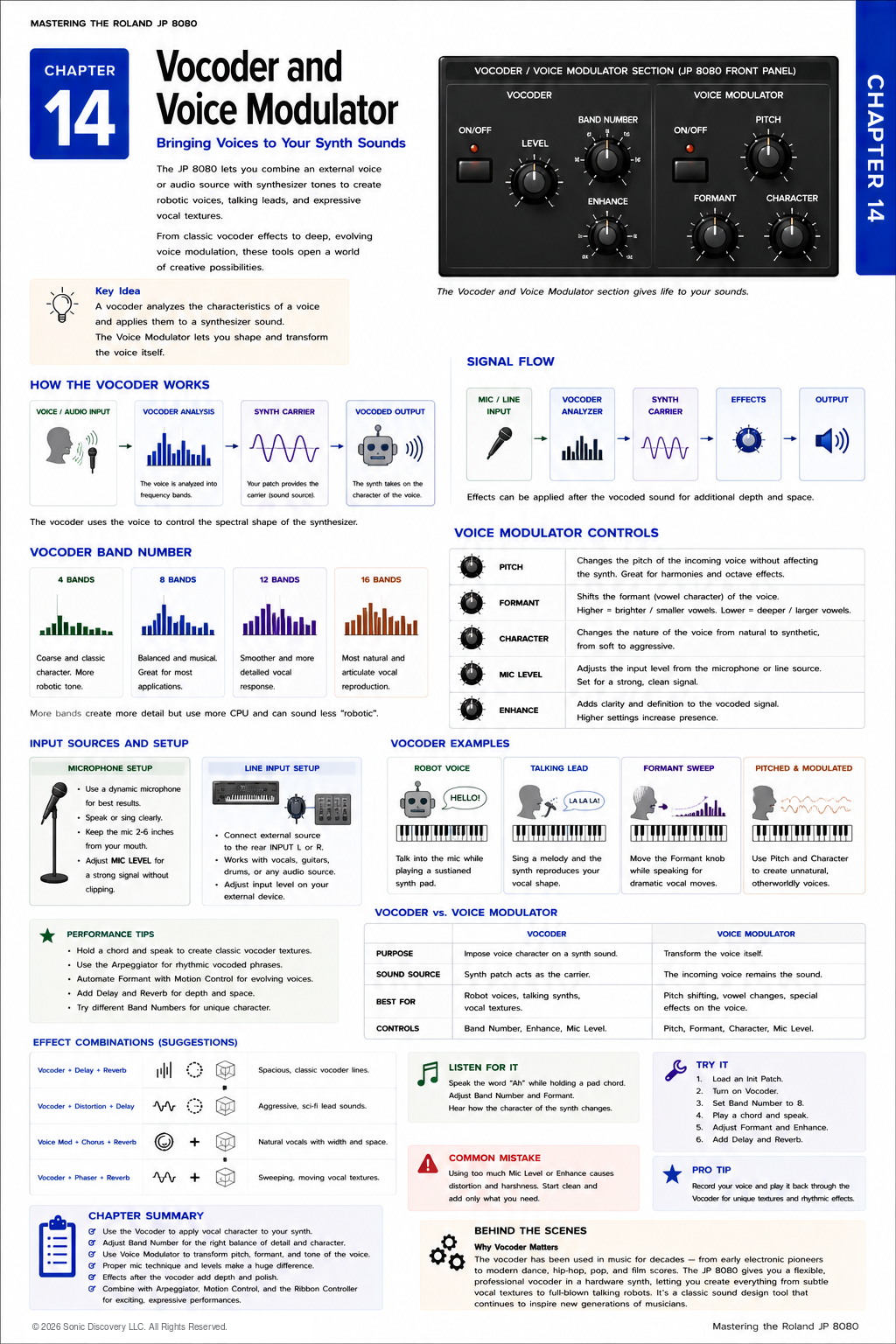
JP-8080 guide / Chapter 14
Vocoder and Voice Modulator
Voice analysis, synth carriers, band count, formants, character, and input setup.
Chapter 14
The human voice is one of the most expressive instruments ever created. The JP-8080 allows you to merge that expression with the power of synthesis.
Among all of the features found on the Roland JP-8080, the Vocoder is perhaps the most recognizable. It is responsible for the famous robotic voices heard in countless electronic, pop, dance, and soundtrack recordings.
However, the Vocoder is capable of much more than creating a talking synthesizer. It allows your voice to control the harmonic character of a synthesizer sound, producing expressive textures that range from subtle vocal pads to futuristic spoken phrases.
The JP-8080 also includes a Voice Modulator, expanding its performance capabilities even further. Together, these features transform the synthesizer into an instrument that literally responds to the human voice.
Understanding the Two Signals
Every vocoder uses two separate audio signals.
| Signal | Purpose | Examples |
|---|---|---|
| Modulator | Provides articulation and the changing shapes of speech. It does not determine the musical notes. | Your voice, spoken words, singing, percussion, or rhythmic sounds |
| Carrier | Provides the musical sound and determines the musical pitch. | Supersaw, strings, choir, pads, brass, or leads |
In short: voice plus synthesizer equals a Vocoder Performance.
How a Vocoder Works
Imagine saying the word “Hello.” Your voice contains constantly changing frequencies. The Vocoder analyzes those frequency changes.
Instead of allowing your natural voice to pass through unchanged, it applies those same frequency movements to the synthesizer sound. The result is no longer your natural voice. It becomes a synthesizer that appears to pronounce the word.
This process happens continuously and in real time.
The Signal Flow
- The microphone captures your voice.
- The Vocoder analyzes the voice.
- The analysis is divided into frequency bands.
- Those changing bands are applied to the synthesizer Patch.
- The finished Vocoder signal reaches the output.
Rather than replacing the synthesizer, the Vocoder reshapes it using your voice.
Why the Carrier Matters
Many beginners assume that the microphone alone creates the final sound. In reality, the quality of the Carrier Patch has a tremendous influence on the result.
| Carrier Patch | Character | Typical results |
|---|---|---|
| Bright Supersaw | Wide and harmonically rich | Powerful electronic vocals, modern dance sounds, and wide stereo textures |
| Warm Pad | Soft and atmospheric | Soft vocal choirs, atmospheric textures, and cinematic soundscapes |
| Brass Patch | Bold and focused | Aggressive electronic speech and retro synth effects |
Choosing the right Carrier is just as important as speaking clearly into the microphone.
Speaking Clearly
The Vocoder follows the shape of your speech. It cannot create words that are not clearly spoken.
For the best results:
- Speak naturally.
- Pronounce consonants clearly.
- Sustain vowels slightly longer.
- Maintain a consistent microphone distance.
The clearer the articulation, the more understandable the final result becomes.
Playing While Speaking
Unlike ordinary speech processors, the JP-8080 requires both speaking and playing. The keyboard determines the musical notes. Your voice determines how those notes are articulated.
For example, hold a C Major chord and speak the word “Welcome.” The Vocoder produces a synthesizer chord that appears to say “Welcome.” Change the chord, and the same spoken word follows the new harmony.
Voice Modulator
The JP-8080 also includes a Voice Modulator. While closely related to the Vocoder, its purpose is slightly different.
Instead of simply creating robotic speech, the Voice Modulator can reshape vocal characteristics for more creative sound design. Depending on the selected settings, it can produce:
- Electronic voices
- Layered vocal textures
- Special effects
- Experimental sounds
Think of the Voice Modulator as another creative tool rather than merely a speech processor.
Microphone Technique
Good microphone technique dramatically improves the quality of the Vocoder.
Maintain a Consistent Distance
Avoid moving closer and farther while speaking. Consistent volume produces more stable results.
Reduce Background Noise
The Vocoder analyzes everything reaching the microphone. A quiet room produces cleaner articulation.
Speak Across the Microphone
Rather than speaking directly into the microphone, angle your voice slightly across it. This helps reduce popping sounds on letters such as P and B.
Practical Examples
| Example | Carrier and speech | Result |
|---|---|---|
| Robotic Announcement | Bright Supersaw with clear spoken phrases | Classic electronic robotic voice |
| Ambient Choir | Warm Pad with long sustained vowels | Lush cinematic vocal textures |
| Dance Hook | Wide Synth Lead with short repeated words | Rhythmic electronic vocals |
| Talking Bass | Aggressive Bass Patch with percussive rhythmic phrases | Powerful dance music effects |
| Cinematic Texture | Strings with whispered phrases | Atmospheric evolving soundscape |
Listen for It
- Select a bright synthesizer Patch.
- Connect the microphone.
- Hold a simple chord.
- Slowly say, “One, two, three.”
- Notice that your natural voice disappears and the synthesizer appears to pronounce each word.
- Repeat the exercise using a warm Pad.
Although the spoken words remain the same, the emotional character changes completely because the Carrier has changed.
Try It
- Select a warm Pad Patch.
- Connect the supplied microphone.
- Enable Vocoder mode.
- Hold a C minor chord.
- Slowly say the vowels “Ah,” “Ee,” and “Oh.”
- Repeat using a Supersaw Patch.
- Compare the results.
Notice how dramatically the Carrier changes the overall sound.
Common Mistake
Many new users focus only on microphone settings. The Carrier Patch is equally important.
If the synthesizer sound lacks harmonic richness, the Vocoder has less material to shape. Bright, harmonically complex Patches usually produce clearer and more intelligible Vocoder results.
Programming Tip
Instead of speaking complete sentences, begin with simple vowel sounds.
Once you hear how the Vocoder responds to “Ah,” “Ee,” and “Oh,” you will better understand how your articulation shapes the synthesizer. From there, gradually progress to words and phrases.
Behind the Scenes
Why did Roland include a Vocoder?
The human voice has always been one of the most expressive sound sources. By combining vocal articulation with electronic synthesis, Roland gave performers a completely new way to interact with the instrument.
Rather than merely triggering notes, musicians could literally shape the synthesizer with speech. This made the JP-8080 particularly appealing for electronic music producers who wanted sounds that blurred the boundary between human performance and machine generated audio.
Even today, the JP-8080 remains admired for the musical quality and immediacy of its Vocoder implementation.
Creative Programming Ideas
| Sound | Programming elements | Result |
|---|---|---|
| Electronic Choir | Warm Pad Carrier, Hall Reverb, Chorus, and long Release | A lush synthetic choir with expressive vocal movement |
| Classic Robot Voice | Supersaw Carrier, moderate Delay, and Small Room Reverb | The iconic robotic vocal sound associated with electronic music |
| Talking Lead | Bright Lead Patch, Ribbon assigned to Filter, and tempo synchronized Delay | Expressive melodic phrases with vocal articulation |
| Cinematic Atmosphere | Strings Carrier, long Reverb, Motion Control on Filter, and slow LFO | A haunting evolving texture suitable for film scoring |
Chapter Summary
- The Vocoder combines a Modulator and a Carrier.
- Your voice provides articulation.
- The synthesizer provides the musical sound.
- The keyboard determines pitch.
- Clear speech produces better intelligibility.
- Bright Carrier Patches often create the clearest robotic voices.
- The Voice Modulator expands the creative possibilities beyond traditional Vocoder effects.
- Microphone technique significantly affects the final sound.
- The Vocoder is both a performance instrument and a powerful sound design tool.