
JP-8080 guide / Chapter 12A
Arpeggiator Beat Patterns Explained
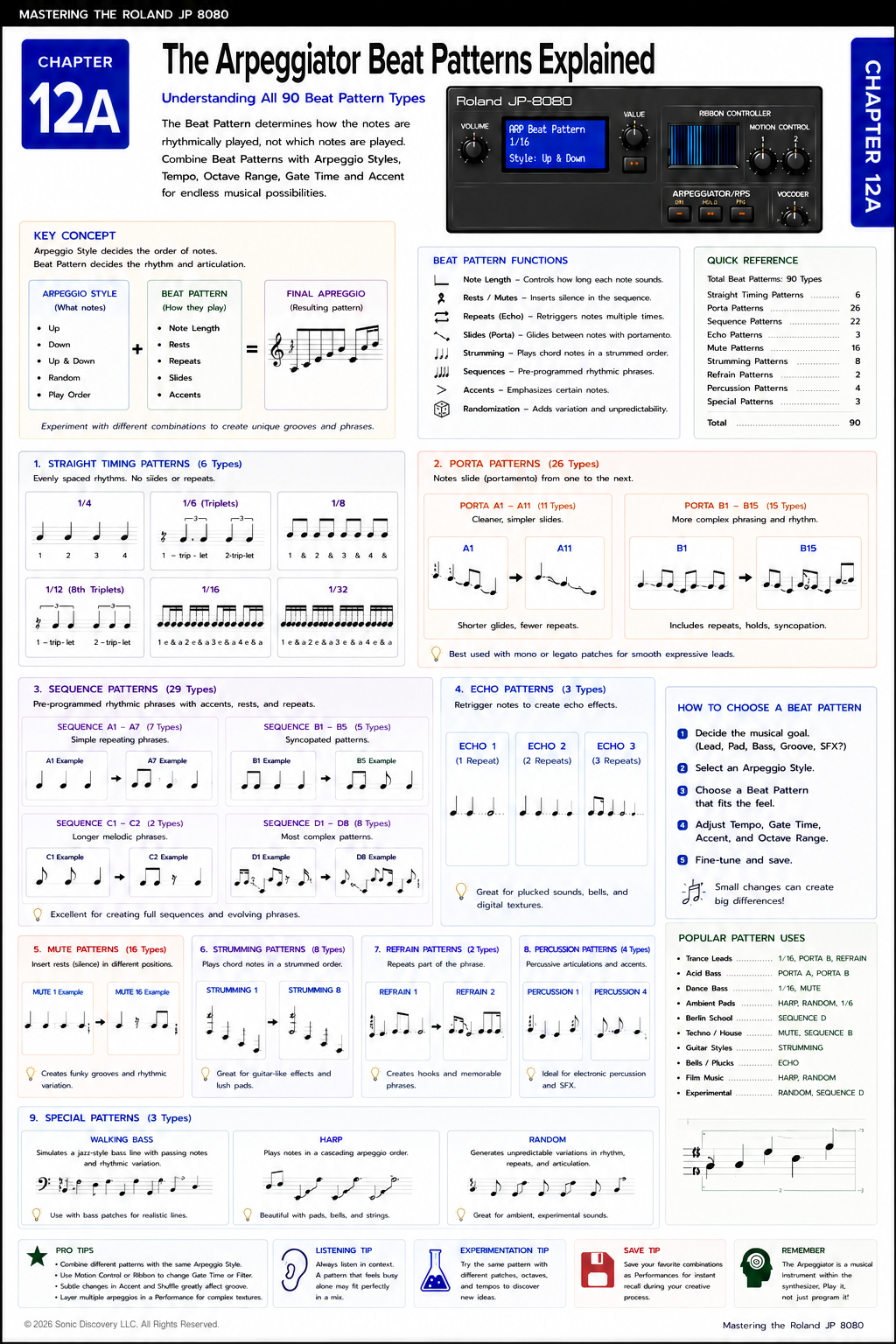
A visual guide to all ninety beat pattern types, from straight timing through special patterns.
Chapter 12A
The JP-8080 Arpeggiator is not simply a note repeater. It is a musical phrase generator.
One of the most overlooked features of the Roland JP-8080 is its exceptionally capable Arpeggiator. At first glance, it appears similar to the arpeggiators found on many synthesizers of its era. After spending time with it, however, you discover that Roland designed something much more sophisticated.
Most arpeggiators answer one question: Which notes should be played?
The JP-8080 asks a second question: How should those notes be played?
That second question is answered by the Beat Pattern.
Once you understand the Beat Pattern system, the Arpeggiator transforms from a simple accompaniment tool into a creative performance instrument capable of producing evolving bass lines, expressive lead phrases, rhythmic textures, and convincing guitar style strumming.
The Three Building Blocks
Every JP-8080 arpeggio is created by combining three independent systems: the notes you play, the Arpeggio Style and Beat Pattern, and the supporting performance controls.
- Choose the notes. The keys you hold determine which notes are available.
- Choose the Arpeggio Style. Up, Down, Up and Down, Random, and related styles determine note order.
- Choose the Beat Pattern. The pattern determines rhythm and articulation.
- Shape the performance. Tempo, Gate Time, Accent, Octave Range, and Shuffle refine the phrase.
| Control | Contribution |
|---|---|
| Keys Held | Which notes are available |
| Arpeggio Style | The order of the notes |
| Beat Pattern | The rhythm and articulation |
| Tempo | Playback speed |
| Gate Time | Note length |
| Shuffle | Rhythmic swing |
| Octave Range | Register |
| Accent | Dynamic emphasis |
When combined, these parameters create hundreds of thousands of possible phrases.
What Is a Beat Pattern?
Many musicians assume a Beat Pattern is simply a drum pattern. It is not.
A Beat Pattern is a performance algorithm. Rather than deciding which notes to play, it decides how each note is performed.
For example, the same four note chord, C, E, G, and B, can sound completely different when you change only the Beat Pattern:
- A straight pattern plays the notes evenly.
- A Strumming pattern offsets the notes to imitate a strummed chord.
- An Echo pattern retriggers each note.
- A Mute pattern removes selected notes and creates rests.
The notes have not changed. Only the performance has changed.
Straight Timing Patterns
These six patterns define the rhythmic resolution.
| Pattern | Rhythmic value | Character | Useful applications |
|---|---|---|---|
| 1/4 | Quarter notes | Slow, stable, and spacious | Ambient music, ballads, film scoring, and slow pads |
| 1/6 | Quarter note triplets | Rolling, flowing, and less mechanical | Jazz influenced music, cinematic scoring, and progressive electronic music |
| 1/8 | Straight eighth notes | Balanced, familiar, and easy to follow | Pop, rock, bass lines, and general sequencing |
| 1/12 | Eighth note triplets | Swinging, groove oriented, and organic | Funk, blues, and progressive styles |
| 1/16 | Sixteenth notes | Fast, precise, and driving | Trance, techno, dance, and electronic bass |
| 1/32 | Thirty second notes | Extremely rapid, energetic, and dense | Sound effects, experimental music, and fast rhythmic textures |
The 1/16 pattern is arguably the most frequently used Beat Pattern on the JP-8080.
PORTA Patterns
The PORTA family introduces Portamento into the phrase. Instead of retriggering every note independently, selected notes glide into one another.
This creates a fluid, expressive performance that closely resembles classic analog monosynth playing.
PORTA A Series
The A series contains eleven patterns. It emphasizes short glides, simple phrasing, smooth transitions, and minimal repetition.
These patterns are excellent for lead solos, analog basses, and acid style lines. As you progress from A1 to A11, the phrases gradually become more rhythmically active while retaining a straightforward feel.
PORTA B Series
The B series contains fifteen patterns and expands on the concept. Compared with the A series, these patterns generally introduce more rhythmic variation, longer glides, repeated notes, and syncopated phrasing.
They are particularly effective for trance, techno, Berlin School, and electronic soundtrack music.
SEQUENCE Patterns
The Sequence patterns move beyond simple repetition. Each pattern contains a unique rhythmic phrase that combines accents, held notes, repeated notes, and rests.
Rather than feeling like a conventional arpeggio, these patterns often resemble a manually programmed step sequencer.
| Family | Patterns | Character | Useful applications |
|---|---|---|---|
| Sequence A | A1 through A7 | Simple repeating phrases | Bass, pads, and basic accompaniment |
| Sequence B | B1 through B5 | More syncopated patterns | House, progressive, and electro |
| Sequence C | C1 through C2 | Longer evolving phrases | Ambient music, film music, and atmospheric textures |
| Sequence D | D1 through D8 | The most complex family, often sounding composed rather than generated | Berlin School, progressive electronic, and experimental sequencing |
ECHO Patterns
Echo patterns simulate repeated strikes without using the Delay effect. Instead of relying on the Effects processor, the Arpeggiator retriggers notes.
The three Echo patterns create natural decay, rhythmic repetition, and bell like articulation. They work especially well with mallet sounds, plucked strings, and digital textures.
MUTE Patterns
Silence is just as important as sound. The Mute family removes selected notes from the phrase.
Instead of changing the notes themselves, these patterns create groove by introducing carefully placed rests. Each of the sixteen Mute patterns removes a different combination of beats.
They are useful for funk, dance, house, and groove based electronic music.
STRUMMING Patterns
These eight patterns imitate the way a guitarist strums chords. Rather than sounding every note simultaneously, each note is delayed by a small amount.
They are effective for guitar emulation, string ensembles, soft pads, and acoustic style accompaniment. Small timing differences create a surprisingly natural result.
REFRAIN Patterns
The two Refrain patterns repeat selected parts of the phrase. Rather than progressing continuously through the notes, short musical ideas are repeated before moving forward.
This behavior is useful for hooks, dance music, pop, and melodic sequencing. The result is often more memorable than a simple linear arpeggio.
PERCUSSION Patterns
These four patterns emphasize rhythm over melody. Their characteristics include short note lengths, dynamic accents, syncopation, and percussive articulation.
They are useful for industrial music, techno, rhythmic effects, and experimental sound design.
Special Patterns
WALKING BASS
This unique pattern imitates the phrasing of a jazz bassist. Instead of moving mechanically between notes, it introduces rhythmic variation that suggests a naturally played bass line.
It works well for jazz, blues, fusion, and cinematic underscore.
HARP
HARP is one of the most beautiful Beat Patterns. Notes cascade naturally from low to high, creating a flowing broken chord.
It is useful for piano, harp, bells, strings, and ambient pads. This pattern excels when combined with long Reverb and slow envelope settings.
RANDOM
RANDOM introduces controlled unpredictability. Possible variations include different rhythmic placement, repeated notes, variable note lengths, and changing accents.
Every performance feels slightly different while remaining musically coherent. It is useful for ambient music, experimental music, generative compositions, and film scoring.
Beat Pattern Family Reference
| Family | Pattern count | Primary behavior |
|---|---|---|
| Straight Timing | 6 | Defines basic rhythmic resolution |
| PORTA A | 11 | Cleaner and simpler Portamento slides |
| PORTA B | 15 | More complex Portamento phrasing and rhythm |
| SEQUENCE | 22 | Programmed rhythmic phrases with accents, rests, and repeats |
| ECHO | 3 | Retriggers notes to create echo effects |
| MUTE | 16 | Inserts rests in different positions |
| STRUMMING | 8 | Plays chord notes in a strummed order |
| REFRAIN | 2 | Repeats part of the phrase |
| PERCUSSION | 4 | Adds percussive articulation and accents |
| Special | 3 | WALKING BASS, HARP, and RANDOM behaviors |
| Total | 90 | All available Beat Pattern types |
Choosing the Right Beat Pattern
The following table provides practical starting points.
| Musical goal | Suggested patterns |
|---|---|
| Trance Lead | 1/16, PORTA B, and REFRAIN |
| Acid Bass | PORTA A and PORTA B |
| Dance Bass | 1/16 and MUTE |
| Ambient Pad | HARP and RANDOM |
| Berlin School | SEQUENCE D |
| Techno | MUTE and SEQUENCE B |
| Guitar Emulation | STRUMMING |
| Bell Sounds | ECHO |
| Film Scoring | HARP and RANDOM |
| Experimental | RANDOM and SEQUENCE D |
Common Mistake
Many new users spend time changing Beat Patterns while leaving every other parameter unchanged. The Beat Pattern is only one part of the equation.
A phrase often changes dramatically when you also adjust:
- Gate Time
- Shuffle
- Octave Range
- Accent
- Tempo
- Arpeggio Style
Experiment with these controls together rather than in isolation.
Programming Tip
After selecting a Beat Pattern, resist the urge to switch immediately to another one.
Instead, spend several minutes adjusting only the supporting parameters. A pattern that initially seems uninteresting can become remarkably expressive with small changes to Gate Time, Shuffle, or Octave Range.
Behind the Scenes
Roland's Design Philosophy
The JP-8080's Beat Pattern engine reflects Roland's focus on musical performance rather than technical complexity. Instead of expecting musicians to program every rhythmic variation manually, Roland provided a library of phrase algorithms that respond dynamically to the notes you play.
This approach allows the instrument to feel more like a responsive musical partner than a simple playback device. Even decades after its release, the Beat Pattern system remains one of the most creative and underappreciated aspects of the JP-8080.
Creative Exercises
Exercise 1: One Chord, Many Phrases
- Hold a C minor seventh chord.
- Without changing the notes, cycle through 1/16, MUTE 5, HARP, RANDOM, and STRUMMING 3.
- Listen to how dramatically the musical character changes.
Exercise 2: Build a Trance Sequence
- Select the Up Arpeggio Style.
- Choose the 1/16 Beat Pattern.
- Set the Octave Range to two.
- Use a moderate Gate Time and light Shuffle.
- Experiment with PORTA B patterns and compare the results.
Exercise 3: Film Score Texture
- Load a slow Pad.
- Select HARP and add long Reverb with a slow Attack.
- Compare the result with the RANDOM Beat Pattern.
- Notice how a single sustained chord develops into an evolving texture.
Chapter Summary
- Arpeggio Style determines which notes are played.
- Beat Pattern determines how the notes are articulated.
- Tempo, Gate Time, Shuffle, Accent, and Octave Range shape the final phrase.
- PORTA, SEQUENCE, MUTE, STRUMMING, and RANDOM are performance algorithms rather than simple rhythm presets.
- Small adjustments to supporting parameters often have a greater musical impact than changing the Beat Pattern alone.
Mastering the Beat Pattern engine transforms the JP-8080 Arpeggiator from a convenient accompaniment feature into one of the instrument's most expressive and inspiring creative tools.